
Somatic Resources: What They Are and How to Use Them
What are somatic resources?
Simply put, somatic resources are things involving your body that help you self-regulate your nervous system and cultivate a sense of calm, connectedness, wellbeing, or safety. Somatic resources can be both internal (qualities or strengths coming from within you) and external (from your environment or relationships).
Why are they important?
Somatic resourcing can be helpful if you feel disconnected from your body, or if you're simply looking for a deeper connection with your body and a greater sense of wellbeing. These practices help regulate your nervous system and signal to your brain that you are safe, strong, and capable.
Somatic resources can be especially beneficial if you've experienced trauma. Trauma is destabilizing and ungrounding, and finding somatic resources can help create new feelings of safety and ease in the present moment. If you have experienced trauma, please consider working with a professional.
When to use somatic resources
You can use somatic resources any time — when you're feeling neutral, or when you're feeling dysregulated: stressed, disconnected, numb, or anxious. It's helpful to first practice connecting with a resource when you're in a neutral or regulated state, so that it becomes easier to reconnect with it later, when you're feeling dysregulated.
Go slowly and titrate these practices if it doesn't feel safe yet to go into your body. Remember that you always have a choice — you can stop, pause, or pivot at any time. If you're working through something difficult or overwhelming, it can help to connect with a resource first to build a sense of internal safety, and
return to that resource any time things start to feel like too much.
Specific somatic resources can help shift your nervous system state from sympathetic arousal, or dorsal vagal shutdown, back to ventral vagal energy. the state of connection and safety.

Examples of
Internal & External Somatic Resources
Internal resource examples:
Positive memories, imaginal resources (visualizing a safe place, protective person, or soothing scene), reflecting on personal strengths such as kindness or resilience, self-compassion, focusing on neutral, warm, or pleasant sensations in the body, tension and relaxation of muscles, slow breathing…
External resource examples:
Comforting objects (stuffed animal, soft blanket, favourite piece of clothing, sentimental object), familiar or comforting scents, wrapping yourself in a blanket, hugging a pillow, connecting with safe and trusted people, glimmers, listening to soothing music or nature sounds, spending time in nature, holding or rubbing a smooth object such as a grounding stone…

Five Specific Resourcing Practices
1. Safe Place Visualization: Create a SIFT Card.
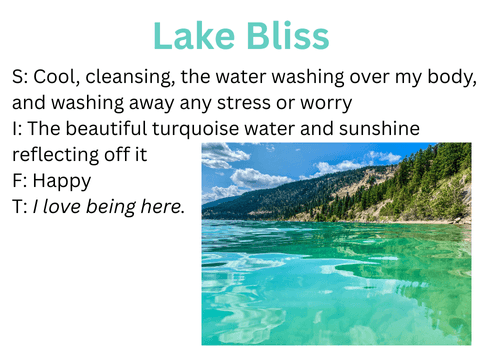
A SIFT card is a resource you can pull out and remember in moments of discomfort or overwhelm to ground and come back to a feeling of safety and calm. SIFT stands for Sensation, Image, Feeling, Thought.
Go through the following questions to create your SIFT card:
1. Is there a place, person, or animal (real or imagined) that brings you a feeling of safety, comfort, or ease? What does it look like? Describe it in detail. (This is the image.)
2. When you imagine that place, person or animal, what emotion is present? (This is the feeling.)
3. What sensations are present in your body when you imagine this?
To get a sensation from a feeling, ask yourself, what does that feel like in my body? Is there a sensation there? (This is the sensation)
4. What thought comes into your mind when you imagine the image, sensation and emotion? (This is the thought)
Once you’ve answered these questions and connected to a felt sense in your body, you can create a physical SIFT card to revisit. Draw or print an image of the place, person, or animal, and write the associated words beside it.
SIFT Card Example
2. Looking for Glimmers
Glimmers are micro moments where we feel awe, wonder, joy.
They are cues that help you move toward a sense of safety, calm, happy, peace, which helps to activate Ventral Vagal nervous system state. How do you know it’s a glimmer? You feel a small shift in your body. Perhaps a shiver of energy, or a slight smile on your lips. You might feel a softening in your face, or a slight warmth in your chest. Notice: how does your body communicate to you that this is a glimmer?
Examples of Glimmers:
Feeling the sun on your skin
The sounds of wind chimes
Hearing your favourite song come on the radio
A cool breeze on a hot day
Smelling fresh coffee
Sunrise
Glimmers are everywhere, but they can be hard to notice because our minds have a natural negativity bias. Looking for glimmers has to be an active, conscious choice. Start looking for them. Keep track of them, and they will start to add up.

3. Gentle Movement, Breath, and Senses
These practices can help if you're experiencing freeze or dorsal vagal shutdown. Gentle movement might include: standing up, swaying, walking or jogging in place, dancing, tensing and releasing your muscles, or wiggling your fingers and toes.
You can combine any of these with breathing that focuses on deeper inhalations, to bring energy back into your body and upregulate your nervous system. You can also engage your senses with comforting smells, visuals, warm or soft textures, or soothing sounds.
4. Comforting Physical Gesture or Posture
Certain body positions, gestures or postures can bring a sense of safety and comfort into the body. These can be self-soothing when you are feeling stressed, overwhelmed, sad, fearful or anxious.
Examples include:
Wrapping yourself in a blanket
Hugging a pillow or stuffed animal
Placing a hand on your heart and feeling its weight
A self-hug: one hand under armpit, the other arm wrapped around to hold your shoulder. Gentle rocking and breathing
Feeling your feet on the floor, grounding into your seat
5. Shake It Off
Shaking your body can be an effective way to discharge sympathetic energy.
Begin by standing with your feet wide and your knees soft. Start to gently bounce your knees, then shake your hands and wrists, letting the shaking move up your arms until your whole body is shaking. Continue until you feel complete. This allows your body to release excess energy from a stress response and come back into balance.
Co-Regulation ♥️
Co-regulation is the process by which one nervous system helps another find safety and calm. It's how we're wired from birth: long before we can self-soothe, we rely on the calm presence of another person to help us settle. That capacity doesn't go away in adulthood; our nervous systems are still constantly picking up cues from the people around us, deciding, often outside of conscious awareness, whether we are safe.
This is a big part of why the relationship between a client and practitioner matters so much in somatic work. When Orissa sits with a client, her own regulated nervous system becomes one of the most powerful tools in the room. A grounded, steady presence can help a client's nervous system borrow that same steadiness and safety.
As a somatic-informed counsellor, Orissa takes her own regulation seriously so that she can offer that steadiness to her clients. Her approach is integrative, blending relational, somatic, and cognitive methods to nurture the mind, body, and nervous system. She believes deeply that we don't need to be fixed, that we are all capable of profound transformation and deserve to feel truly good in our lives.
During sessions with clients, she leans on her own somatic resources, so she can stay present with whatever arises, rather than reacting from her own stress or discomfort. Her hope is that this creates a space where a client's own system can begin to settle, too, and where the deeper work of unpacking old patterns becomes possible.
To book a free discovery call with Orissa and see if you would be a good fit to work together, click the button below:

Orissa Steller
As a professional counsellor, with a background in life coaching and yoga, Orissa offers an inviting space to explore the patterns and beliefs that keep us stuck. Her approach is integrative, blending relational, somatic, and cognitive methods to nurture the mind, body, and nervous system. Orissa believes deeply that we don't need to be fixed, that we are all capable of profound transformation and deserve to feel truly good in our lives. Whether you are navigating mental, emotional, or physical well-being, Orissa helps you unpack what’s holding you back.
In her blog, she writes about mindset, nervous system regulation, and holistic wellness.
Thanks for reading!